November 23, 2026 · Michael Cocchini
Missolonghi, Michael Kokkinis, the Exodus and Bouboulina
#Greece#Missolonghi#Greek War of Independence#Bouboulina#Hydra#heroes
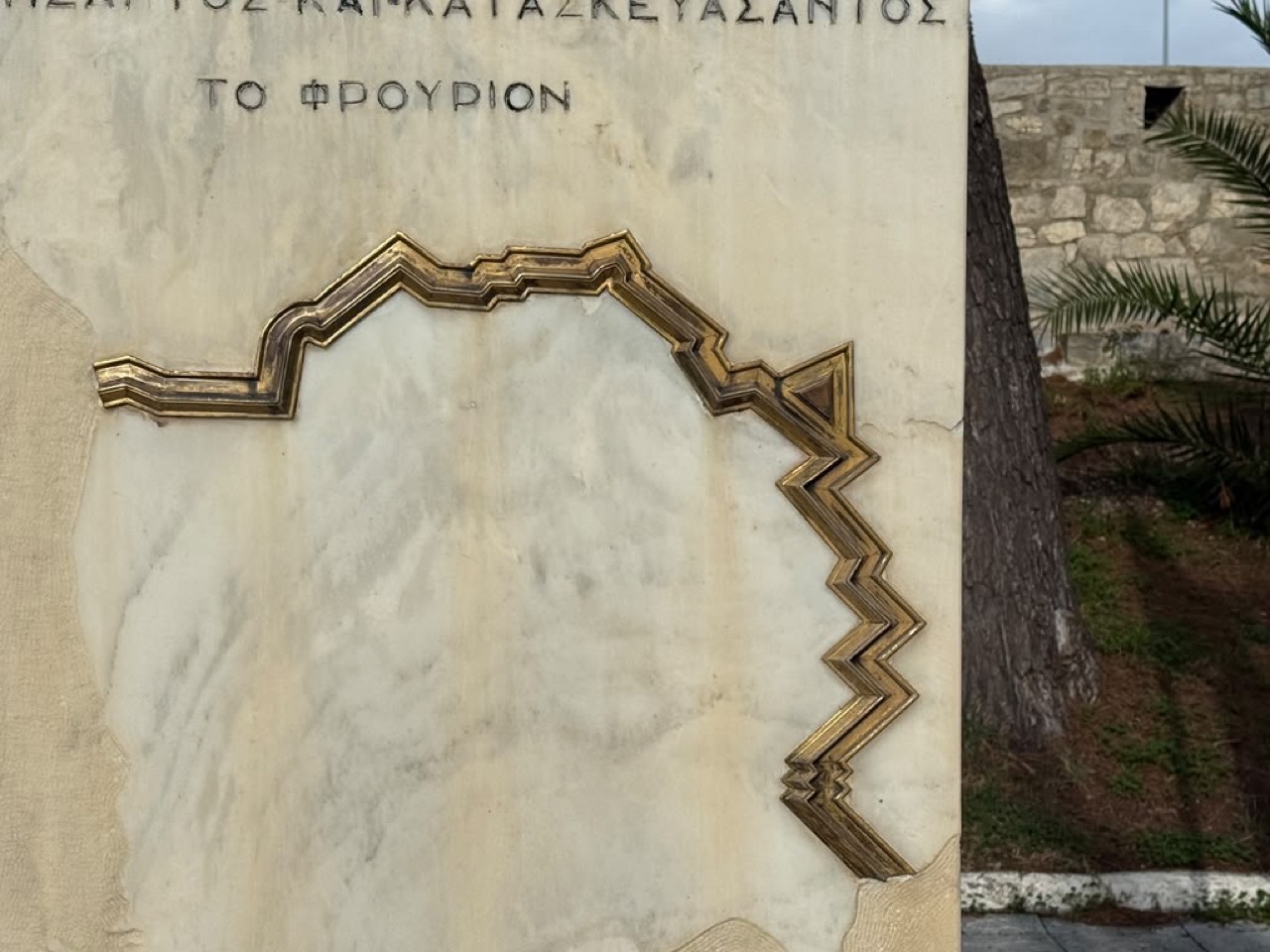
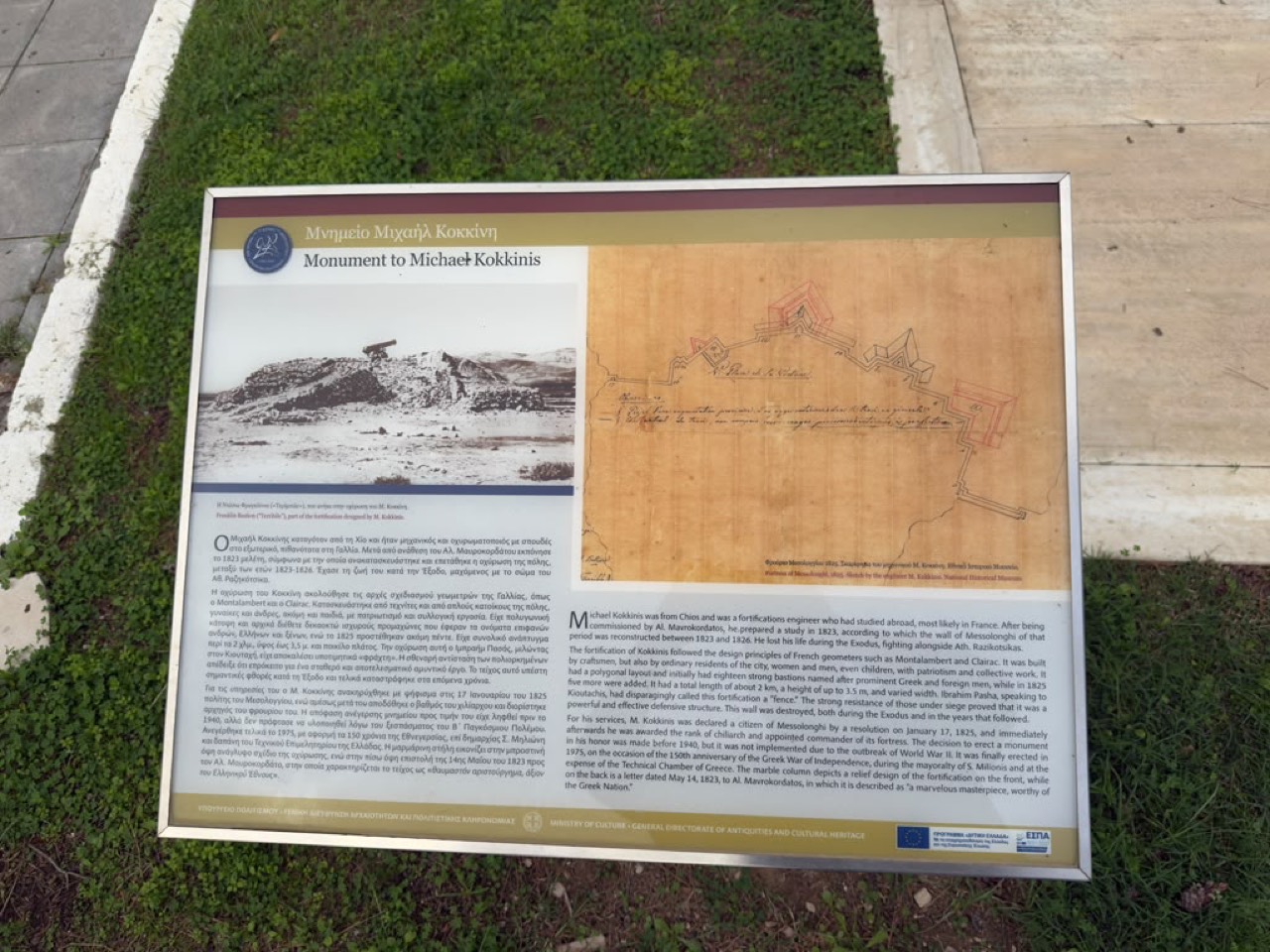
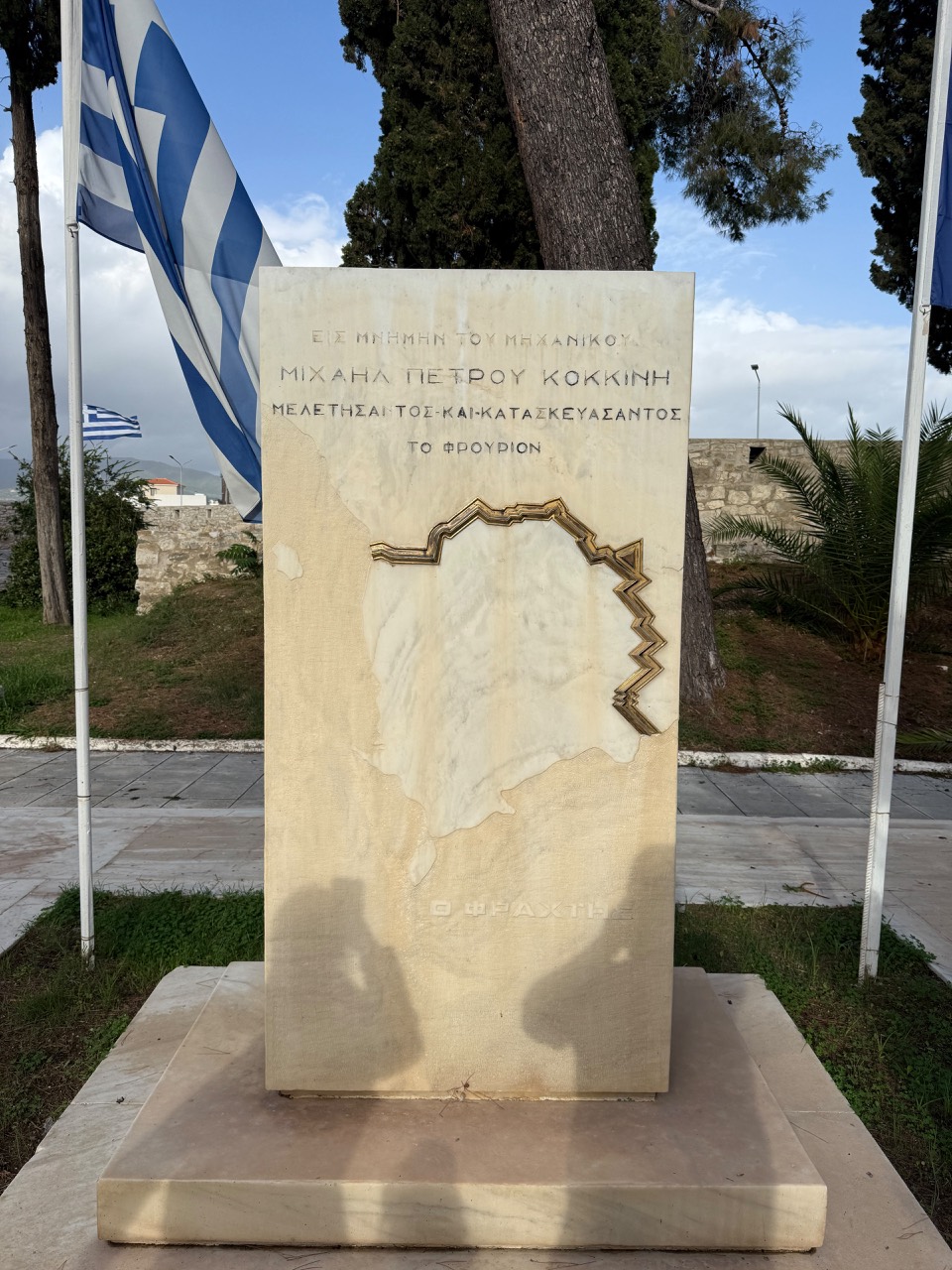
One of our favourite towns in Greece so far is Missolonghi (Messolonghi), and the Cocchini (Kokkini) family has an incredible history here. They are remembered as war heroes! There is even a monument to Michael Kokkinis in the famous Garden of Heroes.
Everyone, from our Airbnb host to the people working in the local cafés, was thrilled to meet us because of the history behind our surname.
The engineer of Missolonghi
In the 1820s, during the Greek War of Independence against the Ottoman Empire, Michael Kokkinis (Μιχαήλ Πέτρου Κοκκίνης) was a military engineer who designed and built the great fortification walls that protected Missolonghi.
The town had already held off Ottoman attacks, and Michael's engineering helped make it one of the strongest defensive positions in Greece.
But in 1825 the Ottoman and Egyptian armies surrounded the town, beginning what would become its last and most devastating siege.
For about a year the Greeks held out against vastly larger forces. In the end the besiegers drove the population to desperation through starvation.
Rather than surrender their town, the Greeks decided to attempt a great breakout through the enemy lines under cover of darkness.
On the night of 22 April 1826, thousands of men, women and children tried to break through the Ottoman siege. Only a small number reached safety. Thousands were killed or captured, and many of those captured were sold into slavery.
Michael Kokkinis was among those who lost their lives in the Exodus.
His wife, Maria Kokkini (Μαρία Κοκκίνη), and their children survived. It seems Michael gave his own life so that they could escape, and was killed that night.
But their suffering did not end there. Historical documents show that after her husband's death, Maria turned desperately to the Greek government for help. On 4 May 1826, less than a month after the Exodus, she petitioned the government because she and her children were starving. She petitioned again in 1829, and again in 1832, complaining that the small allowance she had been granted was not being paid on time.
Michael gave his life defending Greece, and more than SIX YEARS LATER his widow was still fighting for enough help to feed their children.
I am now trying to track down these original documents in the Greek archives.
The fall of the town
The story of Missolonghi becomes even more heartbreaking. Many of the people left in the town were too old, sick or wounded to join the Exodus. When the Ottoman and Egyptian forces entered the town, many civilians were massacred, and others were captured and enslaved.
Some of those who stayed refused to surrender. In one of the most famous acts of the resistance, Greeks gathered around the gunpowder stores, waited for the enemy soldiers to come close, and then blew everything up. Rather than risk slavery, rape or massacre, they chose to die fighting and take their attackers with them.
The Exodus of Missolonghi became one of the most terrible and famous events of the whole Greek War of Independence. The massacre and enslavement of civilians, women and children among them, shocked Europe. It stirred a huge wave of international sympathy for the Greek people and increased the pressure on European governments to step in. In 1827 Britain, France and Russia decisively defeated the Ottoman-Egyptian fleet at the Battle of Navarino, helping to turn the war in favour of Greek independence.
Bouboulina, a Kokkini by blood
The Cocchini/Kokkini name also turns up in another extraordinary chapter of the revolution, this time at sea!
One of Greece's greatest national heroines was Laskarina Bouboulina (Λασκαρίνα Μπουμπουλίνα), a wealthy shipowner and naval commander who gave her fortune, her ships and her life to the fight for Greek independence.
Her mother was Paraskevi (Skevo) Kokkini (Παρασκευή (Σκεύω) Κοκκίνη), daughter of Georgios Kokkinis (Γεώργιος Κοκκίνης), a sailor from the island of Hydra.
Historical sources describe the Kokkini as one of the oldest families of Hydra, with records going back to 1580 and family ties to Zakynthos, and even to the 1300s in Corfu, where the Cocchini helped pay for an Orthodox church together with the famous Kapodistrias and Theotokis families. The church was destroyed by bombing in the Second World War.
Bouboulina (a Cocchini by blood) was born in 1771, while her mother Skevo was visiting her husband, who had been imprisoned by the Ottomans in Istanbul (Constantinople) for his part in an earlier Greek uprising.
After her husband's death, Skevo remarried a sea captain, Dimitrios Lazarou-Orlof. Together they had eight more children, giving Bouboulina eight half-brothers and half-sisters, all of them Kokkini descendants through their mother.
One of those half-brothers, Manolis Lazarou-Orlof (Μανώλης Λαζάρου-Ορλώφ), also became a naval fighter in the Greek Revolution! In April 1821, when the Greeks began the naval blockade of the Ottoman stronghold of Nafplio, Bouboulina arrived aboard her famous warship, the Agamemnon, and her half-brother Manolis arrived beside her, commanding another vessel. Both had Cocchini blood through their mother, Skevo.
Bouboulina became one of the most celebrated figures of the revolution. She spent almost all of her vast fortune on ships, weapons, ammunition and supplies for the Greek army and navy. Her ships took part in major operations at Nafplio and Monemvasia, and she fought in person on land too. Tragically, she was killed in a family dispute in 1825, before Greece won its independence: shot in the forehead by a stray bullet in the dark. Whoever fired it was never arrested. Today she is remembered as one of the greatest heroines of Greek history, and she was posthumously given the rank of admiral.
So while Michael Kokkinis was building the fortifications that protected Missolonghi, other people with Kokkini ancestors were fighting the revolution at sea.
And these are only some of the stories we have uncovered so far. People here know the family name, and they are truly grateful for it.
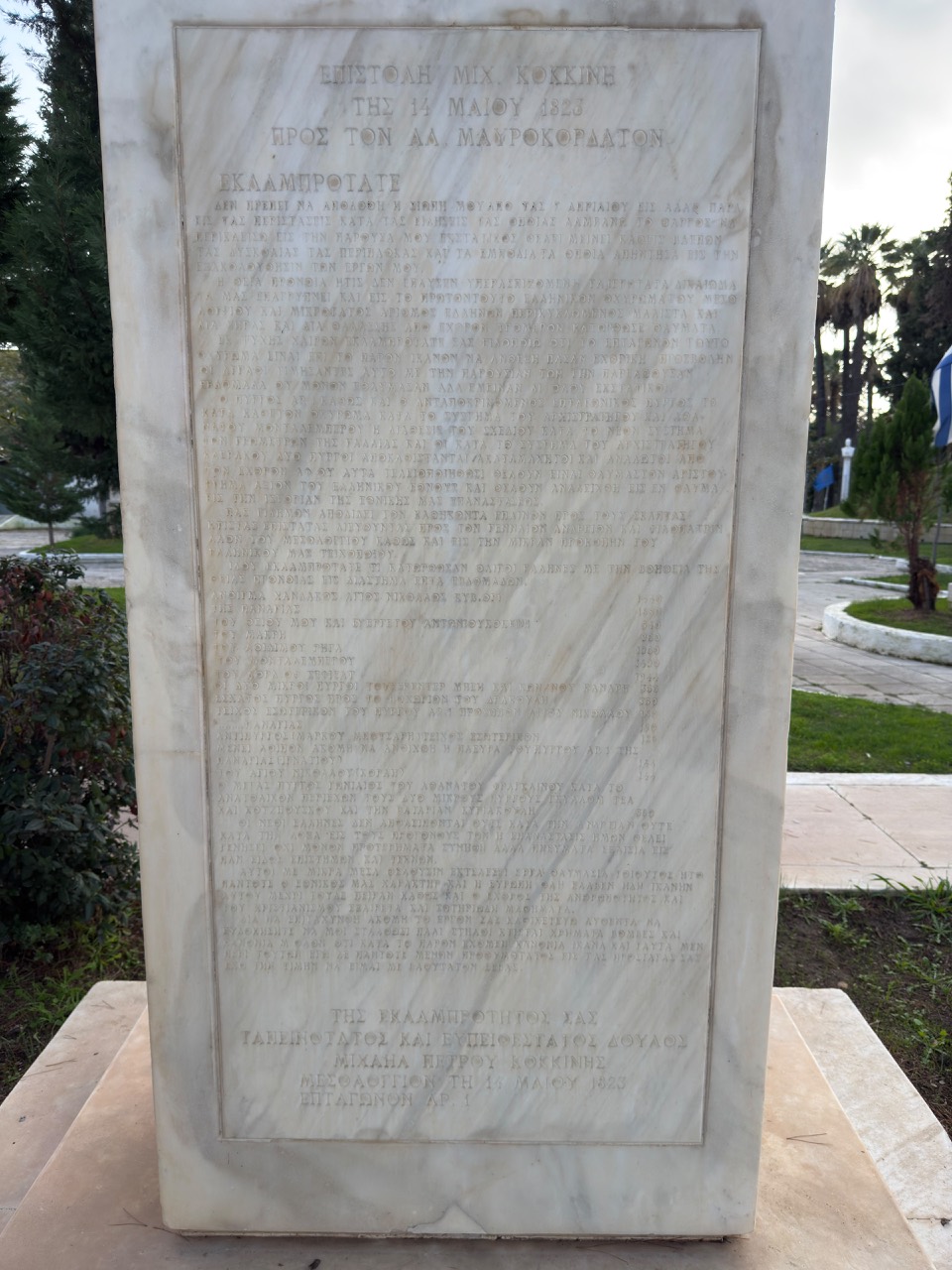
His letter, carved on his memorial
The back of his memorial carries a letter he wrote three years before he was killed in the Exodus. Here it is, translated from the Greek:
Letter of Michael Petrou Kokkinis Missolonghi, 14 May 1823. To Alexandros Mavrokordatos.
Your Excellency,
My silence since 7 April should be put down to nothing but circumstances, of which I take the liberty of informing you in this letter.
Anyone would be astonished to see the difficulties, complications and obstacles I have met in carrying on my works.
Divine Providence, which has never ceased to defend our most sacred rights, watches over this first Greek fortification of Missolonghi as well.
A very small number of Greeks, surrounded by a formidable enemy on land and sea, has worked wonders.
It is with sincere joy, Excellency, that I tell you that this heptagonal fortification is now able to withstand any enemy attack.
The English who honoured it with their presence last week not only admired it but were deeply astonished by it.
The first tower, with its matching heptagonal tower, the perpendicular fortifications built on the system of the great and immortal General Montalembert, the layout of the plan according to the new system of the French geometers, and the two towers built on another system of military engineering are becoming impregnable and invincible before the enemy.
When these works are finished, they will be a marvellous masterpiece, worthy of the Greek nation, and will be remembered as a wonder in the history of our national revolution.
Due praise must go to the diggers, the builders and, above all, to the valiant, brave and patriotic people of Missolonghi, and to the progress of our Greek fortifications.
This, Excellency, is what a small number of Greeks has achieved, with the help of Divine Providence, in the space of just seven weeks!
The excavation and building works include the following sections:
- Trench at Saint Nicholas: 1,440
- At the Panaghia (Virgin Mary): 1,830
- At my uncle and benefactor, Antonio Cocchini: 540
- At Mairi: 960
- At the late Rigas: 1,950
- At Montalembert: 1,490
- At Lord Sheffield: 1,944
- The two small towers of Skanderbeg and Konstantinos Kanaris: 355
- The last tower towards Bochori, associated with Drakoulis: 360
- Inner wall of tower no. 1, towards Saint Nicholas: 150
- Inner wall towards the Panaghia: 180
- Counter-bastion of Markos Botsaris, outer wall: 125
The following works also remain to be dug and completed:
- Side of tower no. 1 at the Panaghia, associated with Ignatius: 144
- Saint Nicholas side, associated with Korais: 144
- Great eastern corner tower of the immortal Franklin, including the two smaller towers of William Tell and Kościuszko and the battery of Kyriakoulis: 560
The young Greeks are not inferior to their ancestors, in courage or in glory.
Our Revolution will give rise not only to ordinary virtues but to extraordinary talents in every branch of the sciences and the arts. With limited means they will achieve wonderful works. Such has always been our national character, and all of Europe has already had ample proof of it. In the same way, the enemy of humanity and of Christendom has received exceptional and salutary lessons.
To speed the works further, I beg Your Excellency to send me workmen, builders, money, bombs and cannon once again, although for the moment we have enough cannon.
In these matters I remain always most ready to obey your orders.
I have the honour to remain, with the deepest respect,
Your Excellency's most humble and most obedient servant,
Michael Petrou Kokkinis (Μιχαήλ Πέτρου Κοκκίνης) Missolonghi, 14 May 1823, Heptagon no. 1
Note his words: "my uncle and benefactor, Antonio Cocchini". The family was building Missolonghi's walls together.